
Chiropractic Assistant
Kiandra Haskins
Hello, I'm Kiandra! Before I started working at the Movement, I was a stay-at-home mom for 7 years. My family is the most important thing to me. My hobbies include acrylic painting, photography, and being outdoors. If I am not out doing something fun with my husband and boys, I love to cook and draw. I look forward to meeting all of the new faces and seeing familiar ones at Movement Chiropractic.
"Kind, professional, beautiful a Dan relaxing office…. Dr Williams has given me the best adjustments I've ever had and I have such better spinal and overall health. Really addresses acute chiropractic and skeletal issues. Thank you!"
- Tonya C.
Title or Question
Describe the item or answer the question so that site visitors who are interested get more information. You can emphasize this text with bullets, italics or bold, and add links.Title or Question
Describe the item or answer the question so that site visitors who are interested get more information. You can emphasize this text with bullets, italics or bold, and add links.
Why is Chiropractic Care Necessary in Harrison AR?
Many of our patients explain a feeling of release following an adjustment. It is also common for our patients to report a significant decrease or disappearance of their headaches following an adjustment.
There are over 300 different techniques out there. Some techniques involve delivering a highly specific and accurate hands-on thrust while another may use an instrument that delivers a light thrust. There are techniques that focus on one region while another works on them all.
Adjustments are used to put your body back to its natural state. Because we are working with bones that are protecting your spinal cords and nerves, we are very skilled. The majority of our patients feel relief following their first adjustment and continuously improve with care. The proof is with our patients that have been in use for decades and generations.
New Paragraph
Auto Accident &
Whiplash Treatment
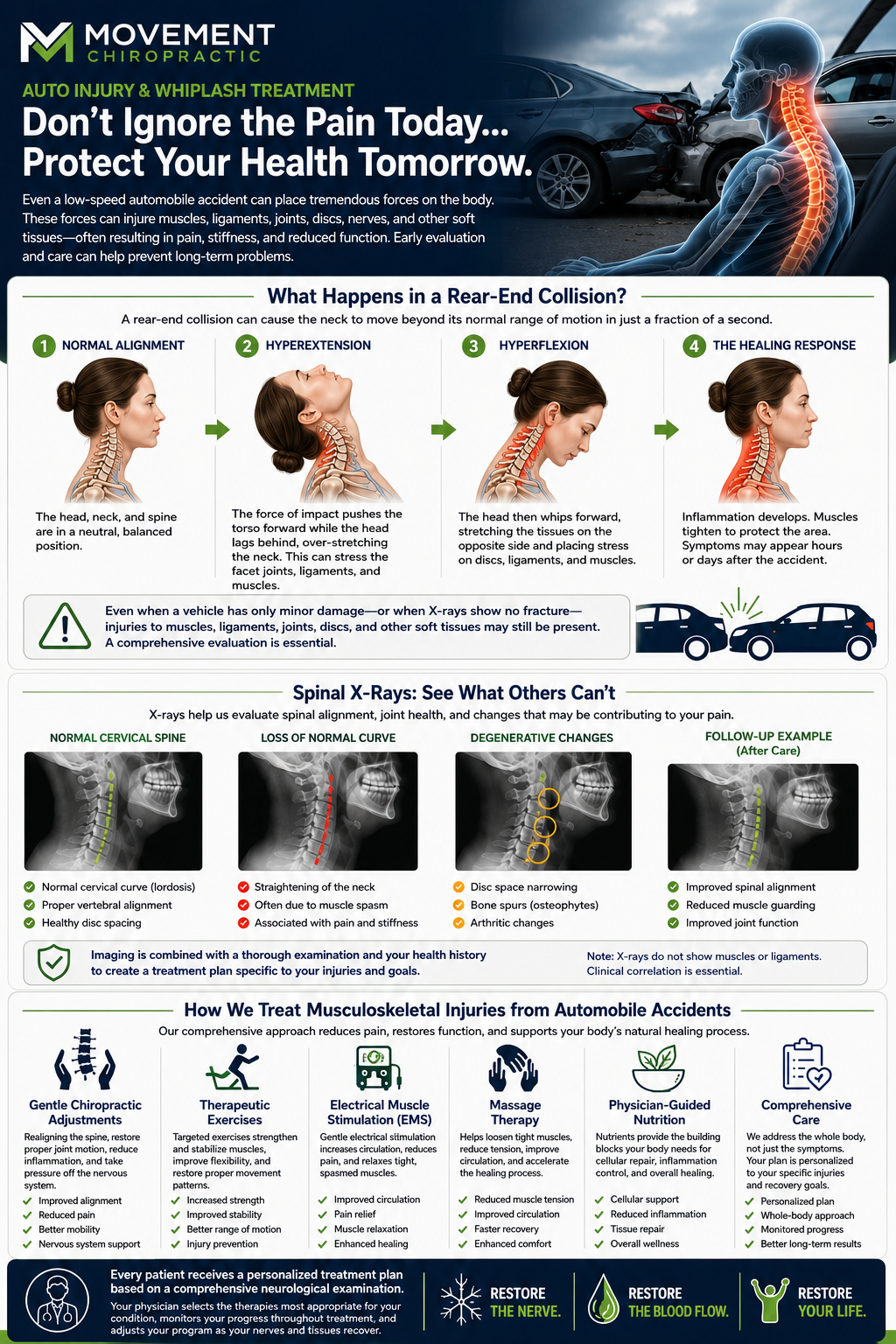
Don't Ignore the Pain Today... Protect Your Health Tomorrow.
Even a low-speed automobile accident can place tremendous forces on the body. During a collision, your body may be thrown forward, backward, or sideways in a fraction of a second while your muscles, ligaments, joints, discs, and nerves attempt to absorb the impact.
Although your vehicle may only have minor damage, your body experiences forces that often exceed what your muscles and joints were designed to withstand.
The result is frequently a combination of sprain and strain injuries affecting the spine and surrounding soft tissues.
What Happens to the Body During an Auto Accident?
An automobile accident doesn't simply cause "neck pain" or "back pain."
The sudden force can injure multiple structures throughout the body, including:
✔ Spinal joints
✔ Ligaments
✔ Muscles and tendons
✔ Intervertebral discs
✔ Nerves
✔ Fascia and connective tissue
✔ Supporting stabilizing muscles
These injuries often create inflammation, muscle spasms, joint restriction, reduced mobility, and irritation of the nervous system.
Because adrenaline and other stress hormones are released immediately following an accident, many people feel little or no pain until hours—or even days—later.
Why Early Treatment Matters
When injured joints lose their normal motion, the surrounding muscles often tighten to protect the area.
This protective muscle guarding can lead to:
✔ Persistent muscle spasms
✔ Reduced range of motion
✔ Ongoing inflammation
✔ Abnormal joint mechanics
✔ Increased stress on discs and supporting tissues
If left untreated, these problems may contribute to accelerated wear of the spine over time. While not every injury results in permanent problems, untreated joint dysfunction and soft-tissue injuries can increase the risk of chronic pain, stiffness, and reduced mobility.
Early evaluation and appropriate treatment are important to help restore normal movement, support healing, and reduce the likelihood of long-term complications.
Our Comprehensive Approach to Auto Injury Recovery
At Movement Chiropractic, we don't simply chase symptoms.
We identify the injured tissues, restore normal joint movement, reduce inflammation, improve muscle function, and support your body's natural healing process.
Every treatment plan is customized to your specific injuries and recovery goals.
Gentle Chiropractic Adjustments
After an accident, injured joints often become restricted and lose their normal movement.
Gentle chiropractic adjustments are used to restore normal spinal motion, reduce mechanical stress on joints, improve mobility, and help optimize nervous system function.
Potential benefits include:
✔ Improved spinal mobility
✔ Reduced joint irritation
✔ Decreased muscle guarding
✔ Improved movement
✔ Support for the body's natural healing process
Therapeutic Rehabilitation
Targeted rehabilitation exercises help restore strength, flexibility, balance, posture, and stability so injured tissues can better support the spine during everyday activities.
Your exercise program is customized specifically for your injuries and progresses as your body heals.
Electrical Muscle Stimulation (EMS)
Following an automobile accident, muscles often become tight, weak, and painful.
Electrical Muscle Stimulation helps activate muscles while supporting circulation and relaxation.
Potential benefits include:
✔ Increased circulation
✔ Reduced muscle spasm
✔ Improved muscle activation
✔ Temporary pain relief
✔ Support for tissue healing
Massage Therapy
Muscle tension frequently develops after an accident as the body attempts to protect injured tissues.
Massage therapy helps relax tight muscles, improve circulation, reduce soft-tissue restrictions, and prepare the body for rehabilitation and chiropractic care.
Potential benefits include:
✔ Reduced muscle tension
✔ Improved flexibility
✔ Better circulation
✔ Enhanced comfort during recovery
✔ Support for soft-tissue healing
Physician-Guided Nutrition
Healing begins at the cellular level.
Your physician may recommend nutritional support to help provide the building blocks your body needs during recovery.
Depending on your condition, recommendations may include nutrients that support healthy connective tissue, normal inflammatory responses, muscle recovery, and overall wellness.
Good nutrition doesn't replace treatment—but it helps create an environment that supports healing.
Your Recovery Is Our Priority
Every automobile accident is different.
That's why every patient receives a comprehensive examination (which may include x-rays) and an individualized treatment plan based on the specific injuries sustained during the accident.
Our goal is not only to relieve your pain but to restore normal movement, improve function, support healing, and help reduce the risk of long-term problems.
Whether you've been injured in a minor fender-bender or a more serious collision, we're here to help you recover safely and confidently.
Move Better.
Heal Better.
Live Better.
Digital Spinal X-Rays
One of the most important steps in evaluating an automobile accident injury is determining exactly what structures have been affected.
When clinically indicated, we utilize digital spinal X-rays to evaluate the alignment of your spine and identify injuries that may not be apparent during a physical examination alone.
Although X-rays do not show muscles, ligaments, or other soft tissues, they provide valuable information about the bones and joints of the spine and help your doctor evaluate:
✔ Loss of the normal spinal curves
✔ Joint misalignment
✔ Areas of abnormal movement or restriction
✔ Degenerative changes that may have existed before the accident
✔ Fractures or other conditions that require referral for additional medical evaluation
Following an automobile accident, muscles and ligaments may become injured even when X-rays appear normal. However, changes in spinal alignment, loss of the normal cervical or lumbar curves, and joint dysfunction often provide important clues about how the body responded to the force of the collision.
By combining your health history, neurological examination, orthopaedic testing, and imaging findings when appropriate, we are able to develop a treatment plan specifically tailored to your injuries.
Understanding a Rear-End Collision
A rear-end collision can subject the neck and spine to significant forces in just a fraction of a second.
Phase 1 – Normal Alignment
Before impact, the head, neck, and spine are in their normal position.
Phase 2 – Hyperextension
As the vehicle is struck from behind, the torso is pushed forward while the head momentarily lags behind. This rapid motion places stress on the muscles, ligaments, facet joints, and other soft tissues of the neck.
Phase 3 – Hyperflexion
The head then rebounds forward, stretching the tissues on the opposite side of the neck and placing additional stress on the discs, muscles, ligaments, and joints.
Phase 4 – The Healing Response
Within hours to days after the accident, inflammation develops and muscles often tighten to protect the injured area. Patients may begin to notice neck pain, headaches, stiffness, muscle spasms, reduced range of motion, shoulder pain, numbness or tingling into the arms, or upper back discomfort.
Even when a vehicle has only minor damage—or when emergency X-rays show no fracture—injuries to muscles, ligaments, joints, discs, and other soft tissues may still be present.
That is why a comprehensive examination and, when appropriate, spinal imaging are so important following an automobile accident.

OFFICE HOURS
Monday
8:00am - 12:00pm
2:00pm - 5:30pm
-----------------------
Tuesday
8:00am - 1:00pm
------------------------
Wednesday
8:00am - 12:00pm
2:00pm - 5:30pm
------------------------
Thursday
8:00am - 12:00pm
2:00pm - 5:30pm
---------
Friday
8:00am - 1:00pm
---------
Saturday & Sunday
Closed
---------

Movement Chiropractic
1602 Merrill Dr.
Little Rock, AR 72211
(501) 615-8615